



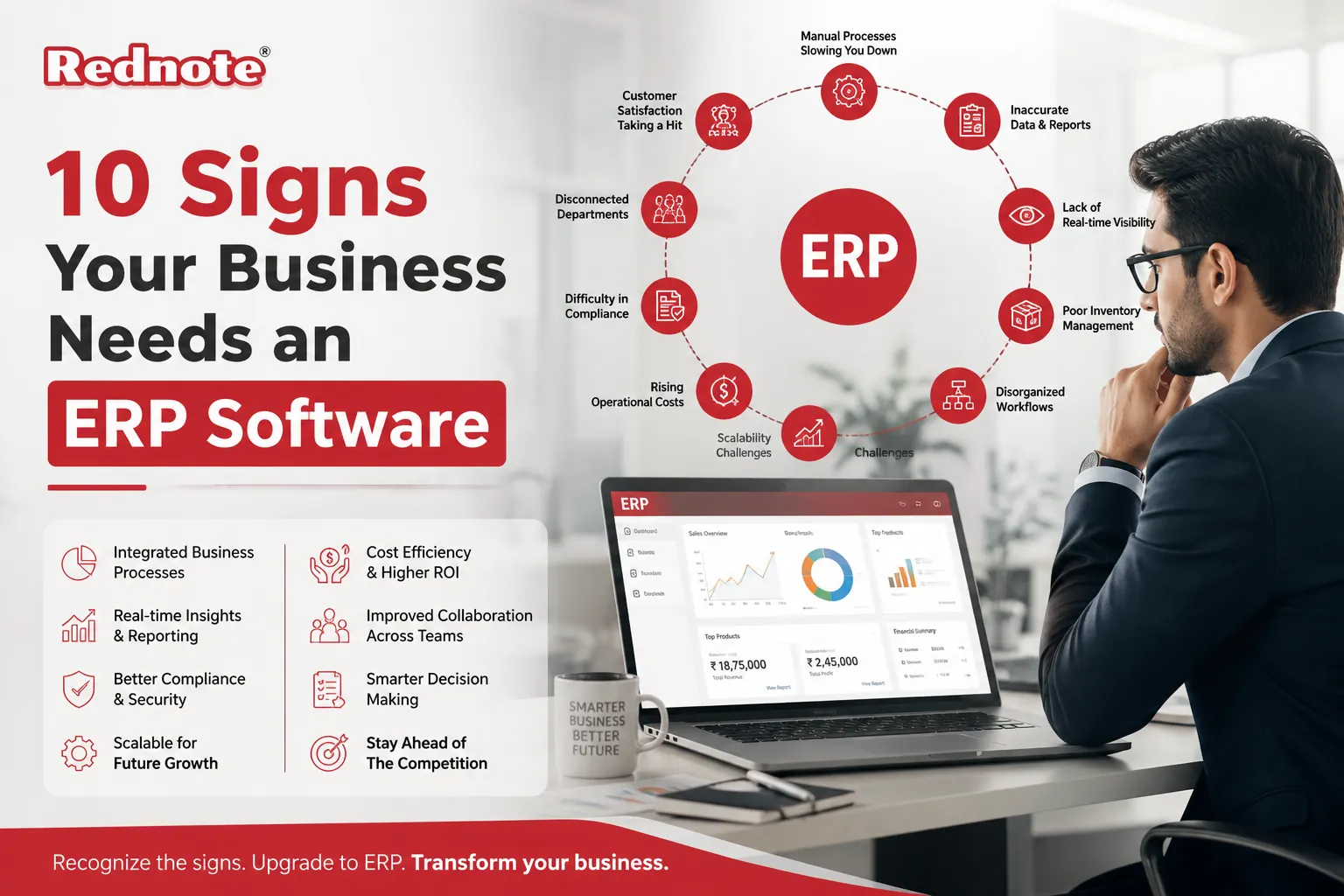
10 Signs Your Business Needs an ERP Software
Running a business gets more complex as your operations expand. Managing finance, inventory, sales, purchasing, and customer information across multiple spreadsheets or disconnected applications can quickly lead to delays, errors, and limited visibility. If your team spends more time resolving operational issues than focusing on business growth, it may be the right time to consider an ERP Software solution.
In this article, you'll see the key warning signs that show your business has outgrown its existing processes. Whether you manage a manufacturing company, wholesale business, or service organization in Chennai, these insights will help you understand when it's time to modernize your operations.
1. Your Data Is Stored in Multiple Places
When different departments rely on separate software or spreadsheets, accessing accurate information becomes a challenge. Sales, finance, and inventory teams may each be working with different versions of the same data, leading to confusion, inconsistencies, and unnecessary delays.
A centralized system removes duplicate records and gives every department access to a single, reliable source of information.
2. Manual Processes Consume Too Much Time
Repeatedly entering the same information into multiple applications slows down productivity and increases the likelihood of errors. Tasks such as manual invoicing, purchase approvals, and report generation also consume valuable time that could be spent on more meaningful work.
Automating routine processes allows employees to focus on strategic responsibilities instead of repetitive administrative tasks.
3. Inventory Problems Are Becoming Common
Frequent stock shortages, excess inventory, delayed deliveries, and inaccurate inventory records are clear indicators that your business needs better operational visibility.
A connected system provides real-time inventory updates, helping businesses maintain optimal stock levels, reduce inventory issues, and improve customer satisfaction.
4. Financial Reporting Takes Too Long
Business leaders depend on timely financial information to make confident decisions. If your finance team spends days compiling reports, decision-making becomes slower and less effective.
An integrated ERP System delivers real-time reporting, making it easier to monitor revenue, expenses, profitability, and cash flow whenever you need accurate insights.
5. Customer Service Is Declining
Customers expect fast responses about orders, invoices, and deliveries. When employees have to search through multiple systems to find the information they need, response times increase and customer satisfaction naturally declines.
Keeping customer information in one centralized system enables quicker, more accurate support and a better overall customer experience.
6. Your Business Is Growing Rapidly
Business growth often introduces operational challenges that manual systems struggle to handle efficiently. As you add more employees, locations, customers, or products, managing day-to-day operations becomes increasingly complex.
Implementing Business ERP Software helps organizations scale smoothly while maintaining consistent processes, better control, and improved operational efficiency.
7. Departments Don't Work Together Efficiently
When purchasing, finance, warehouse, and sales teams operate in separate systems, communication gaps become common. This often results in duplicate work, delayed approvals, and avoidable misunderstandings.
Integrated workflows improve collaboration by ensuring every department works with the same up-to-date information.
8. Compliance Is Becoming More Difficult
Businesses must maintain accurate records for taxation, audits, and regulatory compliance. Relying on manual documentation increases compliance risks and makes audits more time-consuming than they need to be.
Centralized reporting keeps business records organized while simplifying compliance management and audit preparation.
9. Decision-Making Depends on Old Data
Successful businesses rely on timely and accurate information. Waiting for weekly spreadsheets or manually prepared reports limits your ability to respond quickly to changing market conditions.
Real-time dashboards provide current business insights, helping management identify opportunities, address problems faster, and make informed decisions with confidence.
10. You're Looking for Better Operational Efficiency
Many organizations underestimate how much time and money are lost because of disconnected systems and manual processes until they implement a modern solution.
Some of the biggest ERP Software Benefits include increased productivity, improved collaboration, lower operational costs, enhanced reporting, and more effective resource planning.
Why Chennai Businesses Are Investing in ERP
Chennai has emerged as one of India's fastest-growing business hubs, supported by strong manufacturing, automotive, logistics, retail, and IT industries. As businesses continue to expand, managing operations through manual processes becomes increasingly difficult and inefficient.
Choosing the right Enterprise Resource Planning Software helps businesses improve visibility across departments, automate routine tasks, streamline operations, and build a solid foundation for long-term growth while staying competitive in a rapidly evolving market.
Quick Checklist
| Warning Sign | Recommended Action |
|---|---|
| Multiple Spreadsheets | Centralize Business Data |
| Duplicate Data Entry | Automate Workflows |
| Inventory Errors | Improve Inventory Management |
| Delayed Reports | Enable Real-Time Reporting |
| Poor Collaboration | Connect Departments |
| Rapid Business Growth | Implement Scalable Processes |
Conclusion
As businesses continue to grow, disconnected systems and manual processes often become major obstacles to productivity and profitability. Recognizing these warning signs early allows organizations to make informed technology decisions before operational challenges become more expensive and difficult to manage. A well-planned ERP implementation improves collaboration, increases visibility across departments, streamlines everyday workflows, and supports sustainable long-term business growth. If your organization identifies with several of these signs, now is a good time to evaluate an ERP solution that can support your future goals.
Frequently Asked Questions