



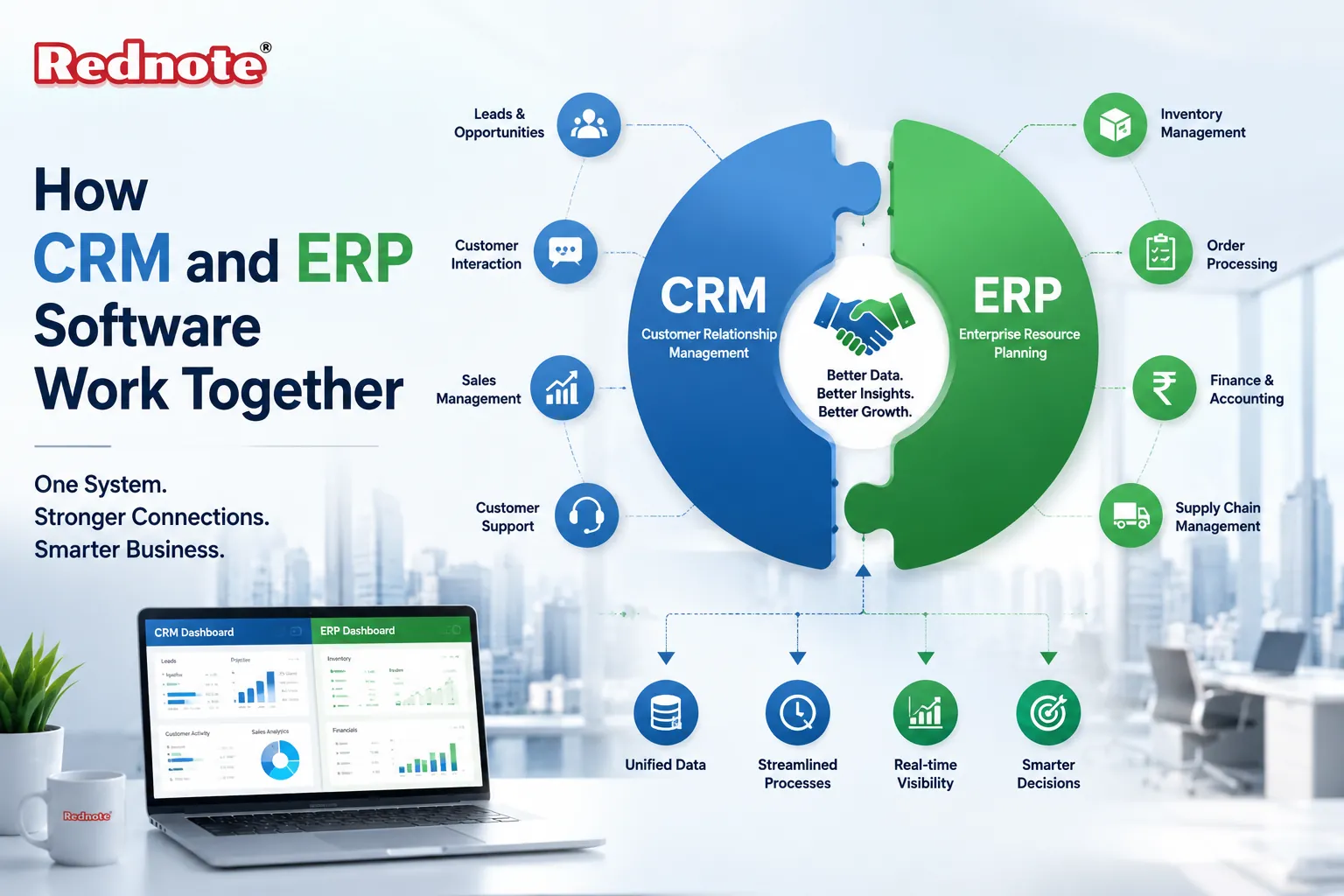
How CRM and ERP Software Work Together
Running a business gets easier when every department works with the same accurate information instead of keeping data in separate systems. CRM and ERP Software connect customer interactions with day-to-day business operations, helping work move smoothly from the first sales conversation to final delivery. Whether you're running a growing company in Chennai or managing an established business, knowing how these systems work together helps reduce manual work, improve efficiency, and give customers a better experience.
Understanding ERP software and CRM software
Both systems support business growth, but each has a different job.
| CRM Software | ERP Software |
|---|---|
| Manages Customer Relationships | Manages Business Operations |
| Tracks Leads and Sales | Handles Inventory, Finance, HR, and Procurement |
| Improves Customer Engagement | Manages Internal Business Processes |
| Supports Marketing and Customer Service | Supports Production and Resource Planning |
When you use both together, every department can access the same accurate business data.
Difference Between CRM and ERP
Many businesses think these platforms do the same job, but each one handles a different part of the business.
A customer inquiry usually begins in the CRM platform. Once the customer confirms the order, the ERP system takes over by managing inventory, invoicing, production, shipping, and financial records.
In simple terms:
- CRM focuses on customers.
- ERP focuses on business operations.
- Integration connects both systems without duplicate data entry.
The result is a smooth flow of information across every department.
ERP and CRM Integration in Daily Business
When both systems are connected, information moves automatically between them.
For example, a manufacturing company in Chennai receives a sales inquiry. The sales team enters the customer's details into the CRM platform. After the quotation is approved, that information moves directly to the ERP system, where inventory is checked, invoices are created, and delivery is scheduled.
This reduces repetitive work and helps keep business data accurate.
Benefits of CRM and ERP Integration
Businesses that connect both platforms usually see clear improvements across daily operations.
Some of the biggest advantages include:
- Better collaboration between sales and operations
- Faster order processing
- Reduced manual data entry
- Improved inventory visibility
- More accurate financial reporting
- Better customer service
- Real-time business insights for decision-making
These benefits become even more useful as the business grows.
Common Mistakes Businesses Should Avoid
Many companies don't get the full value from their software because of avoidable implementation mistakes.
Common issues include:
- Selecting software without understanding business requirements
- Poor employee training
- Migrating inaccurate data
- Ignoring integration planning
- Failing to monitor system performance after deployment
Careful planning at every stage helps businesses get better long-term results.
Choosing the Right Solution for Chennai Businesses
Every business has its own operational requirements. Manufacturers, distributors, retailers, and service providers all follow different workflows and reporting needs.
Before choosing a solution, evaluate:
- Company size
- Industry requirements
- Number of users
- Future scalability
- Integration capabilities
- Technical support
- Implementation timeline
Selecting software that can support your business as it grows helps you avoid expensive migrations later.
Conclusion
Businesses perform better when customer information and operational data work together instead of staying in separate systems. Bringing CRM and ERP together improves communication between departments, reduces manual work, increases accuracy, and supports better business decisions. For organizations in Chennai that want to improve efficiency and customer satisfaction, adopting an integrated business management approach is a practical step toward sustainable growth.
Frequently Asked Questions