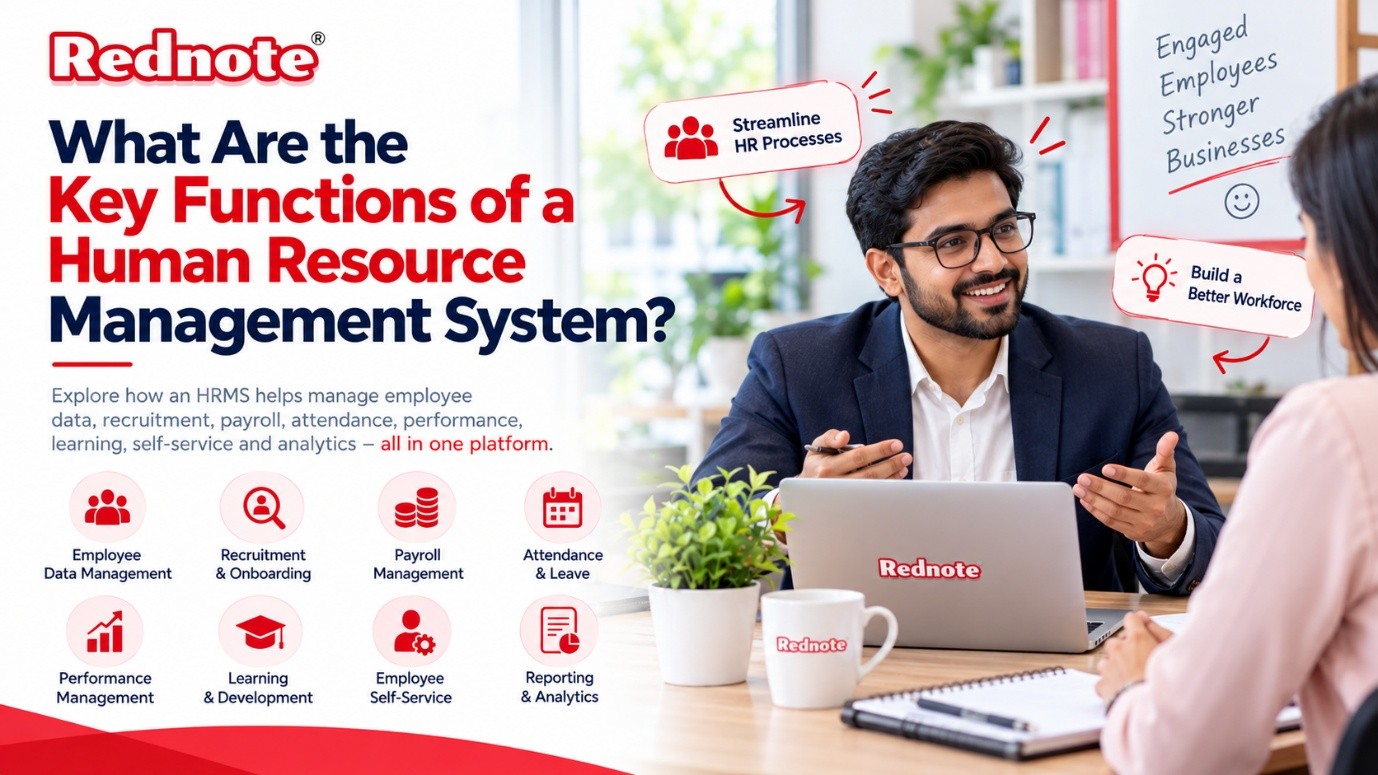
What Are the Key Functions of a Human Resource Management System?
Managing employees involves much more than hiring people and processing salaries. Businesses must maintain employee records, monitor attendance, manage leave requests, conduct performance reviews, and support professional development. A Human Resource Management System (HRMS) helps organisations coordinate these responsibilities through a centralised software platform. For businesses looking to improve everyday HR operations, Rednote recognises the importance of understanding how HRMS software can support efficient workforce management.
What Is a Human Resource Management System?
A Human Resource Management System is software designed to manage employee information and streamline human resource processes. Depending on the solution, it may include recruitment, onboarding, payroll, attendance tracking, performance management, training, and reporting tools.
Instead of maintaining separate spreadsheets and paper records, HR teams can use an HRMS to organise information and automate selected administrative tasks. The exact features depend on the software provider, subscription plan, integrations, and business requirements.
For growing organisations, HR management software can help establish consistent processes while giving authorised employees and managers easier access to relevant information.
1. Employee Data Management
Employee data management is one of the fundamental functions of an HRMS. It provides a central location for storing and maintaining employee information throughout the employment lifecycle.
HR teams may use this function to manage:
- Employee contact details and emergency contacts.
- Job titles, departments, reporting relationships, and joining dates.
- Employment documents and relevant certificates.
- Salary details and employment history.
- Employee status, transfers, promotions, and exit records.
Centralised records can reduce duplicate data entry and make information easier to retrieve. However, organisations should configure access permissions carefully and follow applicable privacy and data protection requirements.
2. Recruitment and Onboarding
Recruitment management helps HR teams organise the hiring process, from identifying vacancies to tracking candidates and coordinating interviews. Some HRMS platforms include applicant tracking system (ATS) functionality, while others integrate with dedicated recruitment tools.
Common recruitment features include:
- Publishing job openings and collecting applications.
- Organising candidate profiles and application stages.
- Scheduling interviews and recording feedback.
- Preparing offer letters and tracking candidate responses.
- Creating onboarding checklists for new employees.
Onboarding technologies can assist in organizing document collecting, policy acknowledgments, orientation, and first training once a candidate joins. These processes create a more consistent joining experience, although effective hiring still depends on human judgement and appropriate candidate assessment.
3. Payroll and Compensation Management
Payroll management supports the calculation and administration of employee salaries. Depending on the system, payroll software may use salary structures, approved attendance records, overtime, leave information, deductions, and applicable benefits to prepare payroll.
Typical functions include:
- Maintaining salary components and compensation records.
- Calculating earnings and authorised deductions.
- Generating payslips and payroll summaries.
- Recording bonuses, incentives, and reimbursements.
- Supporting relevant tax and statutory reporting.
For businesses operating in India, payroll requirements may involve provident fund, employee state insurance, professional tax, tax deducted at source, and other applicable obligations. The relevant rules depend on employee eligibility, location, current legislation, and other circumstances.
An HRMS can support payroll administration, but employers must verify calculations, maintain accurate records, and ensure compliance rather than assuming the software guarantees it.
4. Attendance and Leave Management
Attendance and leave management help organisations record working hours, absences, shift schedules, and time-off requests. Some systems support biometric devices, mobile check-ins, or integrations with attendance applications.
Important capabilities may include:
- Recording employee check-in and check-out times.
- Managing shift schedules and working-hour rules.
- Tracking leave balances and holiday calendars.
- Routing leave applications to the appropriate manager.
- Recording overtime and attendance corrections.
When attendance and payroll modules are integrated, approved time records can help payroll teams prepare salary calculations more efficiently. Managers should still review exceptions, incorrect entries, and unusual attendance patterns.
5. Performance Management
Organizations may set objectives, monitor progress, and record employee development conversations with the use of performance management software. Depending on the platform, managers can record objectives, conduct appraisals, and provide feedback through structured workflows.
Common features include:
- Setting individual and team performance goals.
- Scheduling periodic performance reviews.
- Recording feedback and appraisal outcomes.
- Tracking agreed development objectives.
- Identifying areas where additional support may be needed.
An HRMS can make performance documentation more consistent, but it cannot independently measure every aspect of an employee's contribution.
6. Learning and Development
Employee training helps workers build job-related skills and adapt to changing business requirements. HRMS platforms with learning management capabilities can organise training activities and maintain development records.
These features may include:
- Assigning training courses and learning materials.
- Scheduling induction and compliance training.
- Recording course completion and assessment results.
- Identifying skill gaps and development needs.
- Tracking certifications and renewal dates.
By keeping training records organised, businesses can identify outstanding learning requirements and plan development activities more effectively. The value of this function ultimately depends on the relevance and quality of the training provided.
7. Employee Self-Service
An employee self-service portal allows staff to complete selected HR tasks without contacting the HR department for every request. Availability varies by platform and access permissions.
Employees may be able to:
- View payslips and selected employment information.
- Submit leave requests and check balances.
- Update permitted personal details.
- Access company policies and HR documents.
- Review assigned training and request corrections.
This functionality can reduce repetitive administrative enquiries and improve access to routine information. Sensitive records should remain protected through suitable authentication, role-based permissions, and secure account management.
8. HR Reporting and Analytics
Reporting and analytics help HR professionals understand workforce information and identify patterns that may require attention. Depending on the available modules and data quality, an HRMS can generate reports on headcount, attendance, recruitment, payroll costs, and employee turnover.
Useful reports may cover:
- Department-wise employee numbers.
- Absence and attendance trends.
- Recruitment progress and vacancy status.
- Training completion rates.
- Employee turnover and workforce costs.
These reports can support planning and management decisions. However, historical data does not automatically explain why a trend occurred, so HR teams should interpret results in context and validate important findings.
Key HRMS Functions at a Glance
| HRMS function | Main purpose | Business value |
|---|---|---|
| Employee data management | Maintains employee records | Easier information retrieval |
| Recruitment and onboarding | Organises hiring and joining | More consistent workflows |
| Payroll management | Supports salary administration | Better payroll coordination |
| Attendance and leave | Tracks working time and absences | Clearer attendance records |
| Performance management | Documents goals and reviews | Structured feedback |
| Learning and development | Organises training records | Better visibility of skills |
| Employee self-service | Supports routine employee requests | Fewer repetitive enquiries |
| Reporting and analytics | Summarises workforce data | More informed planning |
How Can Businesses Choose the Right HRMS?
Selecting HRMS software requires more than comparing feature lists. Businesses should assess their workforce size, existing HR processes, budget, reporting requirements, and future plans.
Before choosing a solution, consider these factors:
- Required features: Identify essential modules before evaluating additional capabilities.
- Ease of use: Check whether HR teams, managers, and employees can navigate the platform comfortably.
- Integration: Confirm compatibility with existing payroll, accounting, attendance, or recruitment systems.
- Data security: Review access controls, backup arrangements, data handling practices, and available security documentation.
- Compliance support: Verify whether the software supports relevant local requirements and how updates are managed.
- Scalability and cost: Compare subscription charges, implementation expenses, support, training, and additional-user fees.
Rednote encourages businesses to evaluate HR technology according to their actual operational needs rather than assuming every organisation requires the same features.
Pro Tip
Start with the HR process that creates the most administrative difficulty. If attendance discrepancies regularly delay salary preparation, prioritise attendance and payroll integration. If employee records are scattered across spreadsheets, begin with centralised data management. Test the chosen workflow with a small group, verify data accuracy, train users, and expand gradually.
This approach helps businesses understand practical benefits before committing to a wider implementation.
Conclusion
A Human Resource Management System can support several essential HR activities, including employee data management, recruitment, payroll, attendance, performance reviews, training, self-service, and reporting. By connecting suitable processes, HRMS software can reduce repetitive administrative work and improve access to workforce information.
The right solution depends on an organisation's size, requirements, budget, and compliance responsibilities. Businesses should compare available features, assess security, and verify implementation requirements before making a decision. Through informed technology choices, Rednote highlights how organisations can approach HR process management with greater clarity and consistency.